Exploring Horsts and Grabens: Iconic Geological Fault Blocks
The Earth's crust is a dynamic canvas, constantly being reshaped by immense forces beneath its surface. Among the most dramatic manifestations of these forces are horsts and grabens – elongated fault blocks that tell a compelling story of tension, uplift, and subsidence. These geological structures are not merely academic concepts; they are the architects of some of our planet's most striking landscapes, from towering mountain ranges to deep, expansive valleys. Understanding horsts and grabens provides invaluable insight into the powerful tectonic processes that continue to sculpt our world, creating features that are both geologically significant and breathtakingly beautiful.
Defining Horsts and Grabens: Earth's Tectonic Architects
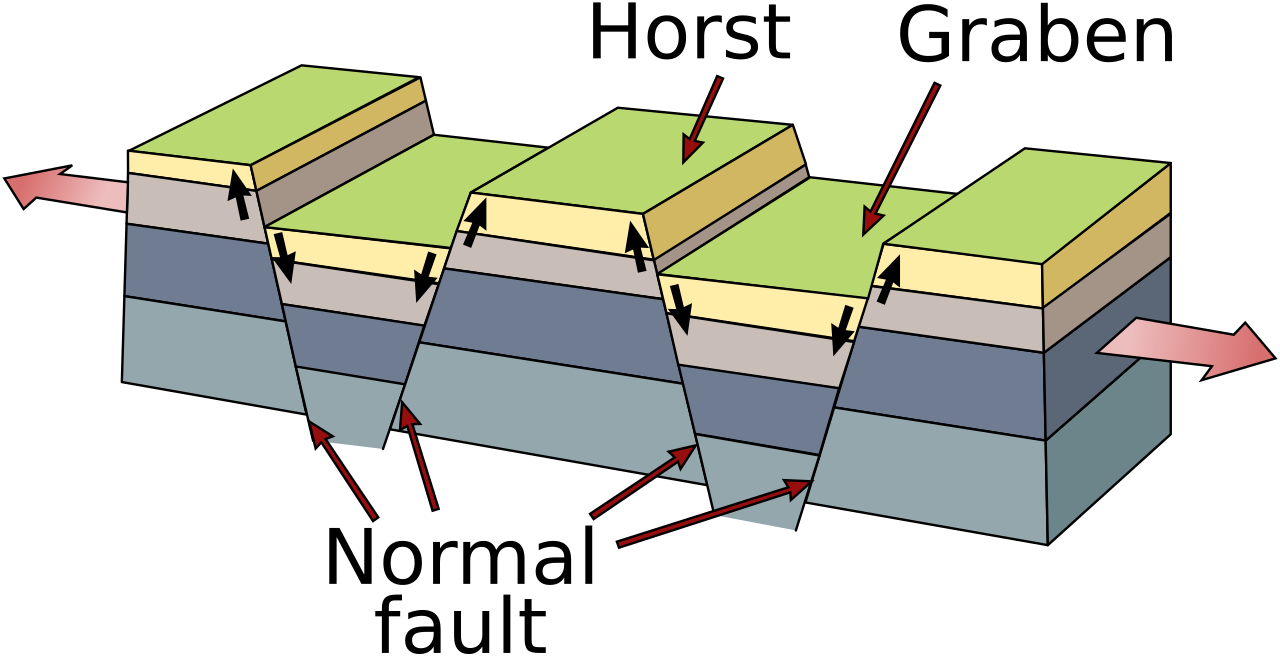
At their core, horsts and grabens are fundamental expressions of extensional tectonics, where the Earth's crust is pulled apart. A
horst is an uplifted block of the Earth's crust, effectively a mountain range or plateau, that rises relative to the surrounding land. Conversely, a
graben is a depressed block, a valley or basin, that has subsided relative to its adjacent areas. Both are direct results of faulting, specifically normal faults, which are characteristic of extensional environments. Imagine a piece of stretched dough; as it thins, sections might rise while others sink, creating a series of peaks and troughs.
These fault blocks can vary dramatically in scale, ranging from features just a few centimeters wide, observable in small rock outcrops, to massive structures spanning tens of kilometers across. The vertical displacement along these faults can be equally impressive, with movements often reaching several thousand feet. What makes them particularly distinctive is their boundary: both horsts and grabens are typically flanked on either side by steeply dipping normal faults. Crucially, movement along these bounding faults is essentially equal, which often results in the blocks themselves being scarcely tilted, maintaining a relatively level surface even as they rise or fall. The orientation of these faults is also telling: faults forming horsts generally dip away from each other, while those forming grabens typically dip towards each other, creating the classic "wedge" shape for the subsided block.
The Dynamic Forces: How Fault Blocks Are Formed
The genesis of horsts and grabens lies in lateral tension within the Earth's crust. This tension is often a byproduct of larger geological processes. One primary driver is
regional uplift, where broad areas of the crust are buoyed upwards, perhaps by mantle plumes or processes related to plate tectonics. As the elevated crust bows upwards, it stretches and fractures, leading to the formation of normal faults. Another contributing factor can be the formation of
salt domes, where buoyant salt deposits rise through overlying sedimentary layers, creating structural domes that induce tension and faulting on their crests. Indeed, horsts and grabens frequently occur on the crests of such domes or larger anticlines.
The mechanics are quite straightforward: as tensional forces pull the crust apart, sections become unstable. When a block of crust is pulled on both sides, and faults form, the central block can either be lifted (forming a horst) or dropped (forming a graben). This process often occurs in conjunction with divergent plate boundaries, where tectonic plates are moving away from each other, causing the crust to thin and stretch. The interplay of these forces, over vast spans of geological time, allows for the creation of multiple adjacent horsts and grabens, forming complex landscapes characterized by alternating raised and lowered terrain. For an in-depth look at these dynamic formations, consider reading our article on
Rift Valleys & Horsts: Earth's Dynamic Fault Blocks Explained.
Global Grandeur: Iconic Examples from Around the World
The geological record is replete with stunning examples of horsts and grabens, many of which have shaped not only the physical landscape but also human history and biodiversity. Valleys formed within grabens are famously known as
rift valleys, and they are often sites of significant geological activity, including volcanism. This volcanic activity is a direct consequence of the crust thinning and fracturing, allowing magma to rise to the surface.
Some of the most iconic grabens on Earth include:
- The Jordan–Dead Sea Depression: This dramatic rift valley forms part of the larger East African Rift System. It hosts the Dead Sea, the lowest point on Earth's land surface, illustrating the profound subsidence that can occur within a graben. The unique geological setting has also created a unique saline environment, home to specialized life forms.
- Death Valley, USA: Located in eastern California, Death Valley is a classic graben in the Basin and Range Province. It is renowned for its extreme temperatures, arid environment, and stunning geological formations, all shaped by ongoing extensional faulting.
On the horst side, equally impressive structures testify to the power of uplift:
- The Vosges Mountains of France: These mountains represent a typical horst structure, uplifted relative to the graben of the Rhine Rift Valley to their east. Their formation is a direct consequence of the rifting process that separated the European and African plates.
- The Palestine Plateau: This region in the Middle East also exemplifies a horst, standing high above the surrounding grabens and contributing to the varied topography of the Levant.
These examples highlight how horsts and grabens contribute to the planet's diverse geography, creating barriers, basins, and unique environmental niches. For more detailed case studies, explore
From Death Valley to Vosges: Understanding Faulting & Tectonics.
Geological Significance and Practical Insights
The study of horsts and grabens goes beyond mere description; it offers crucial insights into broader tectonic processes. These features are fundamental in understanding how continents rift apart, leading to the formation of new ocean basins, or how existing crustal blocks respond to stress. Geologists employ various techniques to study these structures, including:
- Field Mapping: Direct observation and mapping of faults and rock layers.
- Seismic Imaging: Using sound waves to create subsurface images, revealing fault geometries and block movements.
- Satellite Remote Sensing: Monitoring ground deformation over time to track active fault movements.
From a practical standpoint, identifying and understanding horst and graben systems has significant implications for:
- Resource Exploration: Rift valleys, as grabens often are, can be excellent traps for oil and gas due to their sedimentary infill. The volcanic activity associated with them also points to potential geothermal energy resources.
- Infrastructure Planning: Understanding active fault zones is critical for constructing safe buildings, roads, and other infrastructure, particularly in regions prone to earthquakes.
- Water Management: Graben structures can form natural basins for groundwater accumulation, while horsts can define drainage divides.
- Scientific Research: They provide natural laboratories for studying continental rifting, volcanism, and the evolution of landscapes over geological timescales.
When visiting areas known for horst and graben features, observing the distinct changes in elevation and rock types can offer a tangible connection to the powerful forces at play beneath our feet. For instance, the sharp escarpments defining the edges of grabens are often clearly visible, marking the location of the bounding normal faults.
Conclusion
Horsts and grabens are more than just geological terms; they are eloquent testimonies to the Earth's restless energy. These iconic fault blocks, formed by the fundamental processes of tension and faulting, sculpt our planet's surface into a breathtaking array of mountains, plateaus, and valleys. From the deep chasms of the Jordan–Dead Sea depression to the rugged heights of the Vosges Mountains, they remind us of the immense, slow-motion ballet of plate tectonics. By understanding their formation, characteristics, and global distribution, we gain a deeper appreciation for the forces that have shaped, and continue to shape, the very ground upon which we live. They are enduring symbols of Earth's dynamic nature, constantly evolving under the persistent influence of its internal heat and stress.